
When the BBC calls about one of your properties, your first thought isn’t excitement.
It’s “what’s gone wrong?”
BBC Radio 4’s production team contacted Purseglove Property in late October 2025 about the HMOs we manage. They were investigating housing conditions after Lee Anderson MP (Reform UK member and Ashfield’s sitting MP) told them HMOs were the biggest problem in his constituency.
The BBC, seeking a balanced view, started to research HMOs in the area. They came across our website and reached out. They planned to visit a poorly managed property with Lee Anderson, then a professionally managed one to see the other side.
We agreed, and the date was set.
Why the BBC Came to Ashfield
Lee Anderson had been vocal about HMO conditions in Ashfield for months. Poor maintenance, overcrowding, antisocial behaviour. The familiar complaints that follow poorly managed properties.
He’s not wrong about the problems. The same complaints surface in constituencies across the country. It’s the result of investors treating HMOs as high-yield investments and overlooking the level of professional management they require.
The BBC’s production team wanted to explore both sides. Evan Davis would present the segment for Radio 4. They’d visit a problem property first, then contrast with a well-managed example.
That’s where Purseglove Property came in.
The property: Eight-bed HMO in Ashfield
The team: Evan Davis, producer, sound engineer
The brief: Show what professional HMO management actually looks like
One of our tenants, Tim, agreed to be interviewed and to show the BBC his room. At 63, he’d lived in the property for almost two years. His perspective would matter more than any claim we could ever make.
‘It Was a Godsend’: Tim’s Story
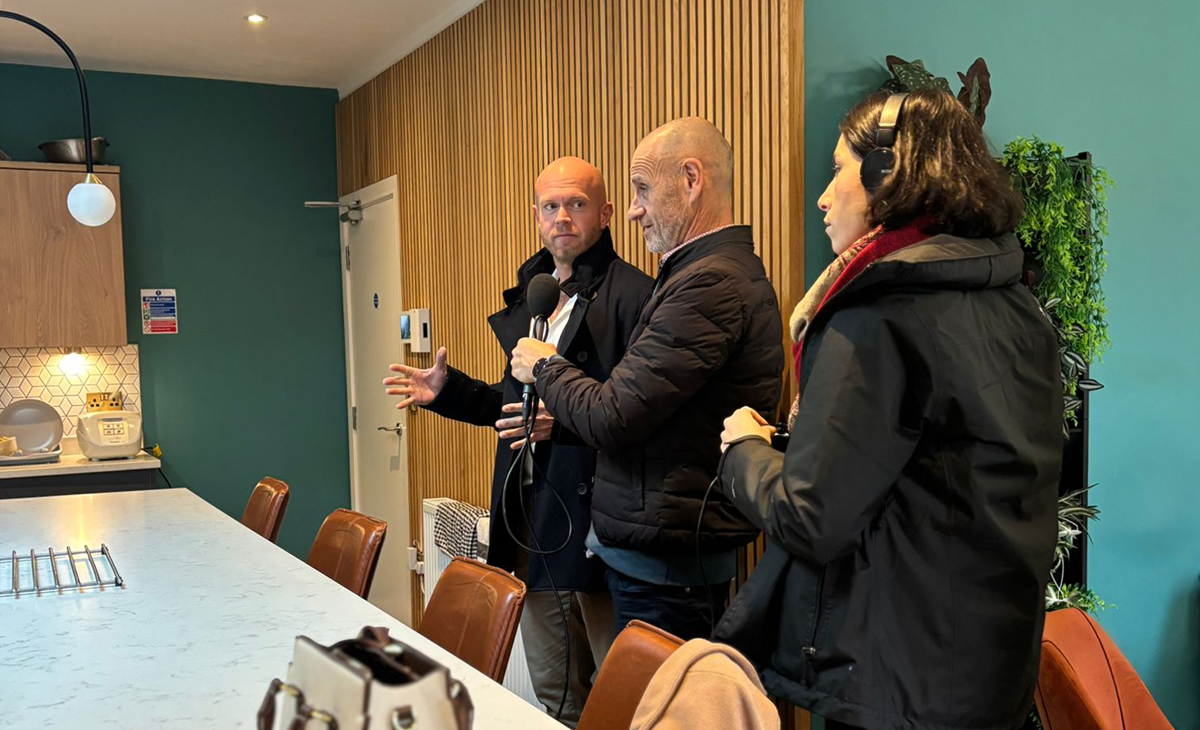
The BBC team were keen to find out everything about the property. They filmed the kitchen and communal areas, and chatted to Rich Purseglove at length about why investors choose HMOs and where we feel the problems lie. They also viewed Tim’s room.
Tim told them his room “was a godsend.”
That single sentence, broadcast on BBC Radio 4, captures what professional management actually achieves. Not luxury accommodation. Safe, clean, well-maintained housing where people choose to stay.
When Tim separated from his ex-partner, he didn’t know HMOs existed. He was facing the prospect of staying with his son, not because of any conflict, but because he didn’t want to be a burden during a difficult transition.
He came across the Purseglove-managed HMO while searching for quick, affordable accommodation. Fully furnished, bills included, no long-term commitment required. It was exactly what he needed.
Initially, Tim planned to stay two to three months while he got his life back on track. He’s now been there almost two years.
His new partner wants him to move in with her, but he doesn’t want to leave. He loves the property and has become part of the small community that lives there.
When a 63-year-old man turns down living with his partner to stay in an HMO room, you’re seeing the outcome of consistent maintenance, fair treatment, and community management that makes a house function as multiple people’s home rather than a collection of strangers paying rent.
The Operations Behind the Outcome
Tim’s story isn’t unusual, we have many tenants like him, from all walks of life. Stories like Tim’s are the result of systems that run across every property we manage.
When there’s an issue, tenants click a link on their phone or scan a QR code and fill in a maintenance form. This goes to our internal maintenance team for immediate review. If it doesn’t require a specialist, we usually fix it the same day. That ensures minimal inconvenience for tenants and saves the property owner money. Small problems get resolved before they become serious and costly.
When a new tenant applies for one of our rooms, we go far beyond the basic referencing most agents do. We treat it like a mini investigation, and this benefits everyone. All tenants know they’re living with someone who has been through the same rigorous process. It mitigates as much risk as possible for the property owner, and it makes our lives easier when it comes to day-to-day management.
These aren’t exceptional events. They’re standard operations that compound into tenant retention. And tenant retention is the foundation of strong HMO returns.
The Financial Reality the BBC Didn’t Have Time For
Radio has time constraints. The BBC segment rightly focused on human stories and political debate.
The financial reality didn’t make the broadcast, despite being discussed at length with Evan afterwards. But for investors, the numbers tell the real story.
Assuming the market demand is there, professional HMO management typically achieves 95%+ occupancy. Average management sits around 85% and that 10% gap has a direct cost.
Let’s use Tim’s property as a worked example.
Eight rooms at £155 per week generates £64,480 per year at full occupancy.
At 95% occupancy (professional management): £61,256 per year
At 85% occupancy (average management): £54,808 per year
The occupancy gap: £6,448 per year. Over five years, that’s £32,240 in lost rent. From a single property.
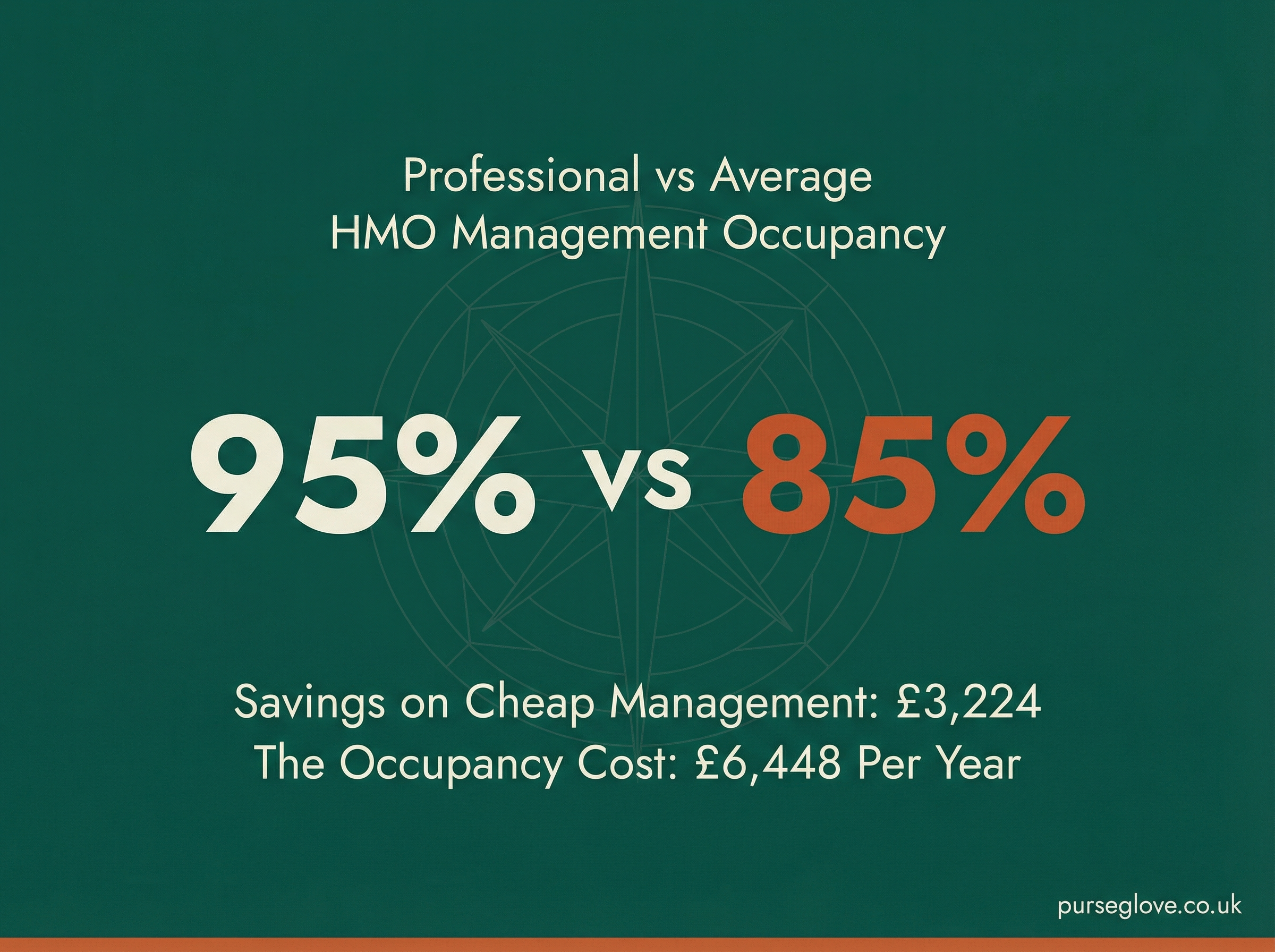
Many investors are swayed by high street agents who have no HMO management experience, offering low rates and incentives to win business. They overlook the fact that there’s a significant cost to running a HMO properly. At 12–15%, which is what you can expect to pay for HMO management across the East Midlands, that’s roughly £7,736–£9,672 per year. Cheap management at 8–10% costs £5,158–£6,448.
The difference in fees: £2,578–£3,224 per year.
But the occupancy gap alone costs £6,448 annually.
For every £1 saved choosing cheaper management, investors typically lose £1.30–£1.50 in increased voids.
Opting for the cheapest management is usually the most expensive mistake an HMO investor can make.
And occupancy is only one metric. Poor management also means corners cut on referencing, maintenance, and compliance. Those costs aren’t always easy to quantify, but when the buck ultimately lands with you as the property owner, is it worth the risk?
Two identical properties on the same street can generate completely different net incomes based purely on management quality. Location, purchase price, and refurbishment costs are identical. The only variable is who manages the property day-to-day.
Most investors fixate on fee percentages because it’s the visible monthly cost. Easy to calculate, easy to compare. Void periods feel like bad luck or market conditions rather than the predictable outcome of inadequate systems.
The numbers never lie. Very few investors take the time to look at the bigger picture.
What Lee Anderson Said After the Broadcast
Lee Anderson’s initial statement to the BBC was clear: HMOs are one of the biggest problems in Ashfield.
After the piece aired, we invited Lee to meet with us. We had a lengthy conversation about where the problem actually lies.
He acknowledged that well-managed HMOs serve a genuine housing need. The problem isn’t the model. It’s investors treating residential property like passive income rather than an active business.
That distinction matters.
During his visit, Lee stated that a debate was needed in parliament about tougher measures around HMO management. He asked if we would support taking this to the House of Commons.
Politicians need evidence when proposing legislation. They need operators who can demonstrate what good practice looks like and explain why certain regulatory approaches work while others create unintended consequences.
That request signals where regulation is heading, and what it means for investors.
Why Regulation Benefits Professional Operators
The Renters’ Rights Act targets poor management through stricter enforcement rather than eliminating HMOs entirely. Councils will gain new powers to fine landlords up to £40,000 for serious breaches. Ombudsman schemes become mandatory and the Decent Homes Standard extends to the private rented sector.
These changes penalise rogue operators. They protect those doing things properly by raising the floor, making it harder for budget investors to undercut on price while delivering substandard housing.
Anderson’s shift from “HMOs are the problem” to “poor management is the problem” reflects a developing political understanding. And it happened within an hour of being in our office.
For investors, this creates a clear direction:
Stricter standards raise barriers to entry. Compliance costs favour scale. Enforcement targets the bottom of the market first. If you’re already operating with professional systems, regulatory tightening protects your competitive position. If you’re relying on budget management and hoping to upgrade later, you’re on the wrong side of the direction of travel.
The window for “good enough” management is closing.
What This Means If You Own or Plan to Own an HMO
Management quality determines returns over the long term. More than location or purchase price. Two investors can buy identical properties and produce completely different outcomes based solely on who manages the property.
Understanding this changes how you evaluate every decision from day one.
HMOs are not passive investments. They’re active businesses requiring professional systems. Emergency callouts at 11 PM for boiler failures. Mediating disputes between housemates. Coordinating contractors across multiple properties. Managing room turnover every 8–12 months. Maintaining compliance with licensing, safety, and planning regulations that change annually.
For overseas investors and busy professionals, this doesn’t mean HMO investment is off the table. It means having the right management infrastructure on the ground is non-negotiable. The returns are there, but only when the operational foundation is solid. Trying to manage remotely with a budget agent is where things consistently fall apart.
Tim has lived in his property for almost two years. His partner wants him to move in with her. He doesn’t want to leave.
This is the outcome of long-term operational thinking. Every decision compounds: maintenance response times, tenant selection, how disputes are handled. Investors focused on decade-long retention make different decisions than those chasing quarterly yield. And over time, those decisions show up clearly in the numbers.
The BBC didn’t visit the property because of clever marketing or aggressive growth tactics. They visited because Purseglove Property has operated in Nottinghamshire for over 15 years, with over 30 years of combined experience across its directors, managing 300+ rooms with systems that produce consistent outcomes. That kind of operational history creates opportunities (political credibility, media validation, tenant testimonials) that cannot be built quickly.
The Evidence Is Already Broadcasting
The BBC visit wasn’t marketing. It was journalism investigating a housing issue raised by a sitting MP.
Watch the complete story, including BBC audio clips, Tim’s full testimonial, and Lee Anderson’s quotes, in this YouTube video breaking down the financial analysis. It covers the behind-the-scenes details and three critical investor risks that didn’t make the broadcast.
If you own HMOs or plan to buy them, request your current occupancy data for the last twelve months and calculate what a 10% improvement would mean to your bottom line and your ROI. That single number tells you whether your management is costing more than it’s saving.